
MyWall vs Influencity: Which Platform Supports End-to-End Campaign Management?
Contents
- What does end-to-end influencer marketing campaign management mean?
- Creator discovery and vetting
- Outreach and relationship management
- Campaign execution and content tracking
- Analytics and reporting
- Which platform fits your team?
- How to plan, execute and measure an end-to-end influencer campaign
- Conclusion
Influencer marketing reached an estimated $32.55 billion in 2025, and 87.49% of marketers expect their budgets to grow again in 2026 (Neal Schaffer). Yet for most brands, finding creators isn't the hardest part. The hard part is everything after the first message: chasing replies, shipping products, approving posts, paying creators, and proving the campaign worked.
That gap is where an influencer marketing platform earns its cost, or doesn't. A tool that only helps you search leaves your team rebuilding the rest in spreadsheets. A tool that covers the whole journey turns one successful campaign into a programme you can repeat every month.
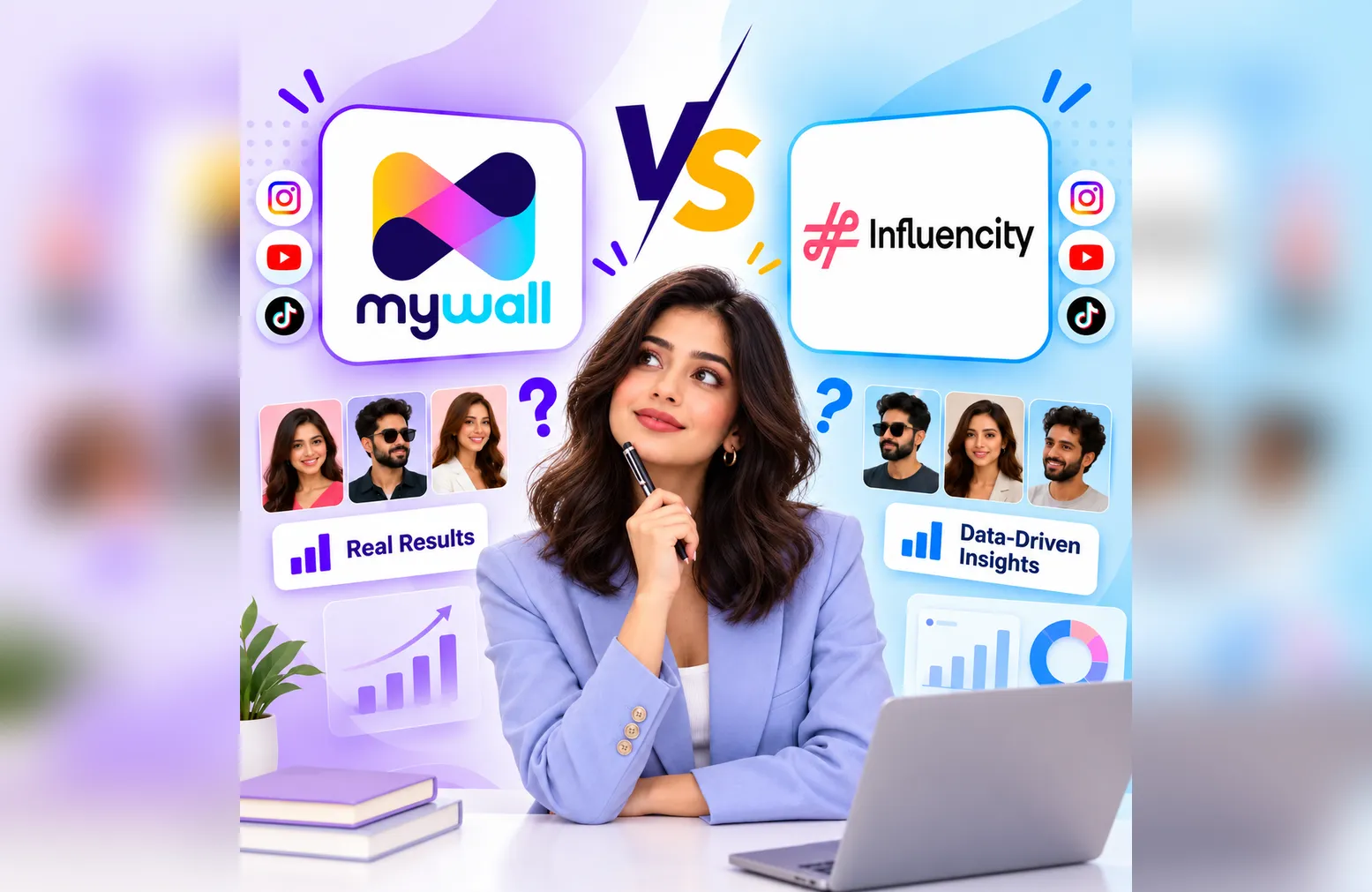
MyWall and Influencity both promise that full journey. The short answer: MyWall is stronger for competitor intelligence, AI-automated outreach, and high-volume barter, UGC, and affiliate campaigns. Influencity is stronger for audience-authenticity analysis, a standalone IRM, and multi-currency payments.
This guide compares the two stage by stage across influencer marketing campaign management: discovery, outreach, execution, tracking and reporting. It ends with a ten-step plan you can use on either platform.
What does end-to-end influencer marketing campaign management mean?
End-to-end influencer marketing campaign management means one platform handles discovery, vetting, outreach, execution, tracking, and reporting, so no stage lives in a separate tool. At minimum, a platform should cover these six stages:
- Discovery: finding creators who match your niche, audience, and budget.
- Vetting: checking engagement quality, audience makeup, and brand-safety signals.
- Outreach: contacting, negotiating with and contracting creators at scale.
- Execution: briefs, product shipping, content approval and payments
- Tracking: logging each live post against the campaign and the collaboration type.
- Reporting: turning views, engagement, clicks and sales into results the business can act on.
If any stage still depends on email threads or spreadsheets, the platform is only part of your workflow, not the whole of it.
Creator discovery and vetting
Both platforms offer AI-assisted creator search with audience and authenticity data. MyWall adds competitor intelligence and a visual content score; Influencity adds a large cross-platform database and a Chrome extension for analysing creators while browsing.
MyWall
MyWall's Creator Discovery tool searches creators across Instagram, TikTok and YouTube, with filters for niche, location, audience demographics, engagement rate, hashtags and content category. Each creator record shows the signals that matter before outreach:
- follower count and average engagement rate
- average views and posting frequency
- audience gender split and audience country
- any active brand partnerships
The brand-partnership signal is especially useful. A creator who already runs sponsored content for a comparable brand is usually easier to brief.
Two features take discovery beyond search:
- MyWall Genie shows which creators competitors work with and what they publish, so a shortlist can start from proven partnerships.
- Fake follower detection and a visual content score help a team judge authenticity and aesthetic fit before reaching out.
Influencity
Influencity says its discovery engine covers more than 350 million creator profiles across Instagram, TikTok and YouTube. Its filters include interests, brand affinity, lookalikes, and fake followers, and a Chrome extension lets marketers analyse creators while browsing. Independent reviewers name its fake-follower and audience-quality analysis as a key reason customers stay.
Outreach and relationship management
Both platforms include a CRM-style layer for creator relationships. MyWall pairs its CRM with AI automation and an inbound creator marketplace, while Influencity centres on a dedicated Influencer Relationship Management (IRM) system.
MyWall
MyWall's built-in influencer CRM includes inbox syncing, message templates and automated follow-ups. AI Executive can handle outreach and follow-ups from a single prompt. A creator marketplace also lets creators apply to campaigns with their rates and past work, so outreach isn't only outbound.
Influencity
Influencity's IRM centralises outreach, communications, contact details and campaign history. Creator profiles stay linked to its analytics engine, so records update as you work.
What to test in a demo
Whichever platform you trial, check that the CRM:
- stops two team members from contacting the same creator
- keeps the brief, agreed rate, usage rights and deliverables in one record
- shows pipeline status at a glance: contacted, negotiating, contracted, delivered
Run this test with a real shortlist on your own account tier, since features can vary by plan.
Campaign execution and content tracking
Execution is where most teams lose time. Both platforms bring briefs, approvals, content tracking and payments into one place, but they lean into different campaign models.
MyWall
MyWall runs barter, paid, UGC, affiliate and product seeding campaigns from one dashboard, covering briefs, contracts, approvals, deliverable tracking and payments. Each live post is logged against a brand, a brand category and a collaboration type (tagged, collaborative or affiliate), together with its views, likes, comments and a link to the post.
That typing matters for reporting. An affiliate post with a trackable link behaves differently in the funnel from a tagged brand mention. Blending the two in one report would overstate or understate performance.
Influencity
Influencity's Campaign Manager brings execution into one workspace. Its content tracking automatically pulls in creator content once a campaign goes live, including Instagram Stories. A payments feature then pays creators once deliverables are approved, including on international, multi-currency campaigns.
Tip: decide each post's collaboration type in the brief, not after it goes live. That one decision keeps measurement clean on either platform.
Analytics and reporting
MyWall reports per post and per creator, alongside affiliate sales and ROI tracking. Influencity offers automated campaign reports and social listening across platforms.
| Dimension | MyWall | Influencity |
|---|---|---|
| Platforms | Instagram, TikTok, YouTube | Instagram, TikTok, YouTube; Twitch for data analysis |
| Discovery extras | Competitor intelligence (MyWall Genie), visual content score | Lookalikes, brand affinity, Chrome extension |
| Relationship management | Influencer CRM with inbox sync, templates and AI follow-ups; inbound creator marketplace | Dedicated IRM linked to its analytics |
| Campaign models | Barter, paid, UGC, affiliate, product seeding | Campaign Manager, plus Shopify-linked sales campaigns with discount codes |
| Tracking | Per-post logging by brand, category and collaboration type | Automatic content tracking, including Stories |
| Reporting | Real-time deliverable and ROI tracking, affiliate sales and commissions | Automated campaign reports and social listening |
| Automation | AI Executive for briefing, matching, outreach, follow-ups and reporting | 60+ native campaign functionalities |
| Pricing | Flat-rate plans; 3-day free trial | From about $168/month, month-to-month; 7-day trial |
Which platform fits your team?
Choose MyWall if you want to discover, learn from competitors, and execute high-volume barter, UGC, and affiliate campaigns with AI doing the follow-up work. Choose Influencity if deep audience-authenticity analysis, a standalone IRM, and multi-currency payouts are your top priorities.
| Your priority | MyWall | Influencity |
|---|---|---|
| Building shortlists from competitors' creator partnerships | Strong fit (MyWall Genie) | Possible through brand affinity filters and paid-collaboration history |
| Barter, gifting and product seeding at volume | Strong fit | General campaign execution through Campaign Manager |
| Automating outreach and follow-ups | Strong fit (AI Executive) | Templates and IRM workflows |
| Heavy fraud and audience-quality screening | Fake follower detection and audience quality analysis | Strong fit; widely cited as a core strength |
| Inbound creator applications | Built-in creator marketplace | Not highlighted on its product pages; confirm with Influencity |
| Trying before committing | 3-day free trial, demo or managed campaign | 7-day free trial |
Neither platform is better for everyone. The right one matches the shape of your next campaign and the way your team prefers to work.
How to plan, execute and measure an end-to-end influencer campaign
Set one KPI before you search, decide each post's collaboration type in the brief, and measure every creator against their own baseline. These steps work on any platform; the notes show where MyWall shortens each one.
Plan
- Pick one primary KPI. Choose awareness (views), consideration (engagement rate), or conversion (affiliate clicks and codes). The KPI decides which filters matter.
- Research the category first. Look at which creators comparable brands already work with. In MyWall, MyWall Genie does this in one place.
- Build a layered shortlist. Start with niche, then add location, a follower band, an engagement-rate floor, and an audience profile that matches your customer.
- Vet before outreach. Check posting frequency, compare minimum and average views to spot one-off viral posts, run a fake follower check, and look for active partnerships with similar brands.
Execute
- Keep outreach in one CRM. Store rates, usage rights, and deadlines with each creator record, not in email threads. MyWall's AI Executive can automate the follow-ups.
- Tag the collaboration type in the brief. Decide whether each post runs as tagged, collaborative, or affiliate before it goes live.
- Approve against the brief. A creator who follows the brief closely gives you cleaner data than one who goes off-script.
Measure
- Report by collaboration type. Group live posts by brand category and type so affiliate results aren't blended with awareness posts.
- Use simple benchmarks. Track like-to-view ratio, engagement rate against each creator's historical average, and cost per engagement.
- Feed results into the next cycle. Re-book creators who matched or beat their baseline, move them into longer-term or affiliate deals, and retire those who consistently fall short.
Conclusion
MyWall and Influencity are both capable end-to-end platforms, so the better choice depends on where your campaigns need the most help.
Choose MyWall if your priority is to start from competitor-proven creators, run barter, UGC, paid, and affiliate campaigns side by side, and let AI handle outreach and follow-ups. All of this sits in one MyWall influencer marketing platform dashboard.
Choose Influencity if your priority is deep audience-authenticity screening, a standalone IRM, and multi-currency creator payments.
Whichever you choose, run one real brief through each platform before you commit. Check how it logs collaboration types and reports results, and confirm current features and pricing with the vendor. To test MyWall on your next campaign, start a 3-day free trial or book a demo.



 820, Golf Course Road Sector 42, Gurugram Haryana -122001, India
 support@mywall.me
 +91 81305 73468


