
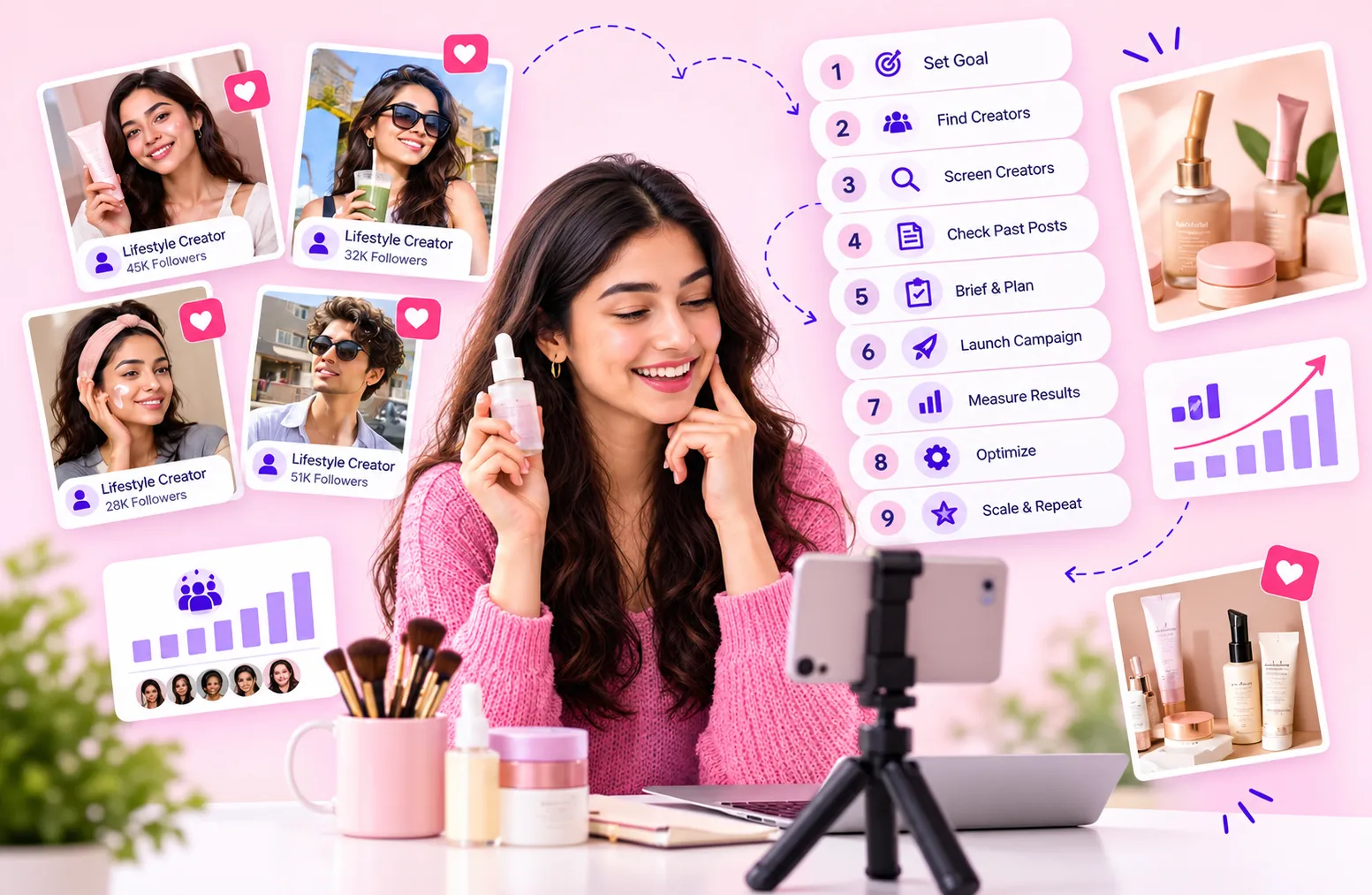
Micro Lifestyle Creator Campaign for Beauty Brands: 9 Steps
Contents
- What Is a Micro Lifestyle Creator Campaign?
- Step 1: Set One Goal and One Metric
- Step 2: Write Your Creator Checklist
- Step 3: Find Creators With Structured Search
- Step 4: Screen Creators With Real Numbers
- Where an Influencer Marketing Platform Like MyWall Fits In
- Step 5: Check Past Beauty Posts, Not Just the Average
- Step 6: Build a Shortlist and Give Each Creator a Role
- Step 7: Send Outreach and a Simple Brief
- Step 8: Measure Results Against the Goal
- Step 9: Avoid the Common Mistakes
- Conclusion
A beauty brand planning its next campaign usually faces the same choice: book one well-known face for a single splashy post, or spread the same budget across several smaller creators who talk about skincare, haircare, or makeup as part of a normal day. The second option is a micro lifestyle creator campaign, a collaboration with creators who have roughly 10,000 to 100,000 followers and post about everyday life rather than beauty alone. It tends to work well for routine products such as a face wash, a serum or a body wash, precisely because the content looks like something the creator would post anyway.
Quick answer: to run a micro lifestyle creator campaign for a beauty brand, set one goal and one metric, write a creator checklist, search the database by follower range and bio keywords, screen creators with real numbers, check their past beauty posts (not just the average), brief a small group with a defined role each, and measure every post against that creator's own baseline. The steps below walk through each part, with real creators and posts from the database as evidence.
The pool is bigger than most teams assume, but beauty fit inside it is narrow. The table below shows what the database actually holds for lifestyle creators with 10,000 to 100,000 followers:
| Segment (10K–100K followers, lifestyle niche) | Creators in database |
|---|---|
| All lifestyle creators | 23,252 |
| …with a recent brand partnership | 11,061 |
| …who name "skincare" in their bio | 919 |
| …who name "makeup" in their bio | 765 |
| …who name "haircare" in their bio | 54 |
| Dedicated skincare specialists (beauty niche, not lifestyle) | 6,958 |
Two things stand out. First, skincare is a far more common bio word than haircare among lifestyle creators: 919 versus 54, a gap of roughly 17 times, calculated from the figures above. If you are running a haircare push, bio keyword search alone will under-deliver, and Step 3 explains what to do instead. Second, dedicated skincare specialists outnumber lifestyle creators who mention skincare by about 7.6 times (6,958 against 919). That is not a reason to avoid the lifestyle tier, it is a reason to search it on purpose rather than defaulting to the beauty niche and missing it.
Scale also helps explain why the micro tier matters at all. The highest-viewed post in the database's Skincare category belongs to a creator with 16,725,173 followers, a Lifebuoy post that reached 261,066,109 views. Most beauty brands cannot book that kind of reach every month, and one mega-creator post does not give the repeated, routine-style content that product education usually needs. Several micro lifestyle creators, briefed and measured properly, tend to produce that steadier drip more affordably, though the database has no spend or ROI figures to prove the comparison, so treat this as a planning rationale, not a measured result.
What Is a Micro Lifestyle Creator Campaign?
A micro lifestyle creator campaign is a paid or gifted collaboration with creators in the 10,000–100,000 follower range whose content mixes fashion, food, travel, routines and beauty rather than beauty alone. Among the five creators profiled in this guide, audiences run 60% to 66% female and posting frequency ranges from once a month to 27 times a month, both numbers worth checking before you commit a budget, since a creator who posts once a month may not fit a campaign with a tight deadline.
This format suits beauty influencer marketing for routine-based products: a face wash, a hair oil, a body wash, something that fits naturally into a morning or evening ritual. It suits it less well for highly technical claims (clinical actives, dermatologist-only language), where a beauty specialist creator with deeper category knowledge may be the safer pick. Either way, the real test is the same: has this person posted about beauty recently, and did those posts perform in line with their other content?
Step 1: Set One Goal and One Metric
What to do: Define the primary outcome the campaign should achieve, such as product awareness, video views, audience engagement, website traffic, or sales. Select one primary KPI that aligns with that objective, then establish how and when it will be measured. If the campaign aims to generate traffic or sales, set up tracked links, unique codes, or other suitable attribution methods before launch.
Why it matters: the metric decides which creators and which content format qualify, and it decides how you read the results afterward. A views goal rewards a short, punchy Reel. A comments goal rewards a direct question in the caption or a "comment for the link" mechanic. Both show up in the data: @ianjalisingh07's affiliate post for Winq Cosmetics uses "Comment for Link" and collected 114 comments, and @sanskrati_pathak's affiliate post for Juice Cosmetics uses the same wording and collected 96 comments. If the goal is conversation, that mechanic is worth building into the brief; if the goal is reach, it may not be the right call since comment-gated links can cap how many people act immediately.
Decide these four things before searching:
- Content job: launch, routine or tutorial, seasonal push, or sale.
- Main metric: views, comments, saves, or link clicks. If it's clicks, build the tracked link or code into the brief now, not after the posts go live.
- Product category: skincare, makeup, haircare or body care. This guide's examples lean skincare and haircare.
- Budget: how many creators, and whether you're paying a fee, sending product only, or both.
Write down what a miss looks like too. It is easy to read numbers generously once the posts are already live and money is spent.
Step 2: Write Your Creator Checklist
What to do: Build a written checklist covering follower range, relevant beauty content, audience demographics, location, language, posting frequency, previous brand collaborations, and preferred content formats. Separate essential requirements from desirable qualities, and define any exclusions before searching for creators.
Why it matters: A predefined checklist makes creator evaluation more consistent and reduces the risk of choosing someone based only on an attractive profile or a single high-performing post. It also helps brands compare candidates against the same criteria, explain shortlist decisions to stakeholders, and identify potential mismatches before committing campaign budgets.
- Follower range: 10,000 to 100,000.
- Beauty fit: skincare, makeup or haircare named in the bio, plus actual past beauty posts (bios can overstate this, Step 5 has an example).
- Audience: a gender split and interest set that matches your buyer. Among the creators profiled here, female audience share runs 60% to 66%.
- Posting frequency: enough activity to hit your deadline. The creators profiled post anywhere from once a month to 27 times a month, a once-a-month creator needs a longer lead time built into the brief.
- Language and market: captions should match where you sell.
- Brand experience: evidence they've already worked with brands, so deadlines and disclosure rules aren't new territory.
- Format: Reels, static posts, or both, decided before you search.
Step 3: Find Creators With Structured Search
What to do: Begin with lifestyle creators in the 10,000–100,000 follower range, then narrow the results using relevant filters such as audience location, language, brand collaboration history, and beauty-related interests. Use bio keywords such as "skincare," "makeup," and "haircare" to identify potential candidates, then expand the search to relevant hashtags and past brand collaborations when bio searches return limited results.
Why it matters: filters do the heavy cutting that would otherwise take hours of manual scrolling. For a lifestyle creators for skincare search, three passes work well:
- Broad: lifestyle niche, 10,000–100,000 followers, recent brand partnership. This returns 11,061 creators.
- Narrow by bio: add the bio keyword "skincare." This returns 556 creators who both have brand experience and name skincare in their bio, a workable shortlist pool for a skincare campaign.
- Narrow by past work: for categories where bio keywords are scarce, haircare returns only 54 lifestyle bios against 919 for skincare, pull brand collaboration posts filtered by category instead of relying on bio text.
Bios can still mislead even after filtering. @sanskrati_pathak has 41,181 followers and lists "Lifestyle • Skincare • Fashion • UGC • Makeup" in her bio. @ianjalisingh07 has 18,320 followers and writes "Lifestyle | Fashion | Skincare" with "Real reviews only."@vibeverssee also lists "Skincare" among her interests. All three fit the follower range and name skincare, yet their actual beauty post histories differ sharply, as Step 5 shows, which is the whole reason filtering is only the first pass, not the final decision.
Step 4: Screen Creators With Real Numbers
What to do: Record each candidate's follower count, average views, engagement rate, posting frequency, and recent post performance. Compare these metrics across a consistent sample of posts and investigate unusually high or low figures. Where possible, review audience demographics and authenticity indicators alongside the numerical data.
Why it matters: these numbers tell you which of the hundreds of filtered results deserve ten minutes of closer reading. They do not, by themselves, tell you whether a creator is a good fit, bios and bio claims can inflate the picture.
Compare views with followers, not just engagement rate. @vibeverssee has 25,717 followers, 191,532.38 average views (6.17% average engagement rate), about 7.4 times her follower count in views. @lifestylewithpreeti__ has 16,149 followers but only 1,227 average views (0.49% engagement rate), about 7.6% of her follower count. The first deserves a closer look; for the second, ask for current numbers before agreeing a fee.
Read bio claims against the actual average. @lifestylewithpreeti__'s bio states "67M+ Viral Views," yet her average per post is 1,227 views. That is not necessarily dishonest, it is likely a lifetime or best-post figure rather than a typical one, but it is a reminder to ask for an average, not a headline number, before shortlisting anyone.
Quick filter to apply this week:
- Drop profiles whose average views are tiny next to their follower count.
- Drop profiles with no beauty signal in the bio, hashtags, or listed interests.
- Flag any profile where one number (views, engagement, or a bio claim) looks extreme, and verify it by hand before shortlisting.
Where an Influencer Marketing Platform Like MyWall Fits In
The creator screening process becomes more demanding when a beauty brand repeats campaigns across multiple product lines or markets. An influencer marketing platform such as MyWall can support the workflow by bringing creator discovery, shortlisting, outreach, campaign coordination, and performance tracking into one workspace, subject to the platform's available features.
For beauty brands, the key is to use technology to organize and accelerate research, not to replace judgment. Teams should still verify recent beauty collaborations, review individual posts, assess audience relevance, and confirm campaign terms before selecting creators. Combining structured discovery with post-level evaluation helps brands make more informed decisions and build a repeatable creator campaign process.
Brands that want a faster starting point can also browse MyWall's curated beauty and lifestyle influencer lists before running a filtered search of their own.
Step 5: Check Past Beauty Posts, Not Just the Average
What to do: for each shortlisted creator, pull their individual brand collaboration posts and note the highest and lowest views, the brand category, and the collaboration type.
Why it matters: an average hides the range, and your post will land somewhere in that range, not at the average itself.
Example 1: a bio that doesn't match the post history. @vibeverssee's bio names skincare among her interests, but none of her nine brand collaboration posts in the database sit in a beauty category. They span snacks, honey, breakfast oats, perfumes and two festive sarees, her highest, a Diwali gifting post for nourishyouindia, reached 407,812 views, while her lowest, amyfitness breakfast reel, reached 2,759. Her overall profile-level minimum (across all posts, not only brand collaborations) is just 266 views, well below any of her tracked brand posts. None of this means she is a poor creator, it means a beauty brand should ask for beauty-specific examples before booking her on a skincare bio mention alone.
Example 2: a genuine beauty and haircare record. @sanskrati_pathak has multiple skincare and haircare brand posts, and the views vary widely:
| Post | Views | Category | Type |
|---|---|---|---|
| Thrive Co haircare | 201,123 | Haircare, Skincare | Collaborative |
| Aalim Hakim hair colour | 175,462 | Salon & Beauty Services | Collaborative |
| Pears body wash | 52,571 | Skincare | Collaborative |
| The Pink Foundry face wash | 24,752 | Dermatology & Clinical Skincare, Skincare | Collaborative |
Against her 41,181 followers, the top post here is about 4.9 times her follower count in views; the lowest of the four is about 0.6 times. Plan budgets and expectations for a range, not a single number. Her two La Serentiqa skincare posts, worth noting separately, are tagged rather than collaborative, confirm how a post was actually disclosed before assuming a paid relationship, and make sure your own brief states the disclosure wording your market requires.
Her single biggest post in the whole database is not beauty at all: a saree collaboration that reached 7,572,595 views. @madhoodamaraju shows the same pattern, her highest-viewed post is an ethnic-wear collaboration at 203,207 views, well above herBody Shop skincare post at 89,697 views. Sorting either creator's posts by raw views alone would surface fashion content first. Filter by brand category before you sort by views, or you'll end up shortlisting the wrong post as your proof point.
Watch for odd gaps. One @sanskrati_pathak makeup post from June 2024 shows 41,025 views against just 3 likes. A gap that wide between views and likes is worth asking about directly, it doesn't necessarily disqualify the creator, but it's the kind of number a brand should understand before paying for similar content.
Step 6: Build a Shortlist and Give Each Creator a Role
What to do: choose a small group and assign each person a specific content job rather than asking everyone for the same post.
Why it matters: five similar creators posting the same format teach you little about what actually works. A deliberate mix shows which format and which creator suit your product.
| Creator | Data points | Possible role |
|---|---|---|
| @sanskrati_pathak | 41,181 followers, 4.1% engagement rate, 27 posts/month, strong haircare and skincare post history | Routine-style post, higher posting cadence |
| @ianjalisingh07 | 18,320 followers, 6.64% engagement rate, 18 posts/month, 2 of her 3 tracked brand posts are beauty category | Product-focused short video |
| @madhoodamaraju | 47,181 followers, 3.47% engagement rate, only 1 post/month, bio "Cinema•skincare•travel" | Festive or seasonal beauty post, with a longer lead time |
Notes worth flagging to the brand team:
- @ianjalisingh07: her face mask post for mytaupereached 24,591 views and 106 comments on 18,320 followers, about 1.3 times her follower count in views. Her profile-level lowest post sits at just 38 views, so ask for recent performance before setting expectations.
- @madhoodamaraju: her Body Shop post reached 89,697 views but only 2 comments, suggesting she suits a views-driven goal better than a conversation-driven one. Her posting frequency of once a month means a festive-timed brief needs to be locked in well ahead of the date.
Keep the shortlist small enough that you can brief, review and track every post properly, a longer list only helps once you know which roles actually work.
Step 7: Send Outreach and a Simple Brief
What to do: send a short outreach message first, then a one-page brief once the creator agrees.
Why it matters: a vague ask produces a generic post; an over-scripted one produces something that reads like an ad rather than the creator's own routine.
The outreach message should include:
- The product and the content job from Step 1.
- Fee or product value.
- Deadline, with extra lead time for low-frequency posters.
- Usage rights and how long the brand can reuse the content.
- One specific post of theirs that prompted the outreach, it signals you actually looked at their work.
The brief should fix:
- Facts and claims: required product facts, and claims to avoid.
- Disclosure: wording that matches your market's advertising rules.
- Deliverables and CTA: how many Reels or stories, and where the link or code goes. "Comment for the link" is a pattern that shows up repeatedly in the data, both @ianjalisingh07's Winq Cosmetics post (114 comments) and @sanskrati_pathak's Juice Cosmetics post (96 comments) use it, so it's a reasonable default if the goal is engagement rather than immediate clicks.
- Review rounds: a limit, such as one edit round within 48 hours, so posts don't stall near the deadline.
Fix the facts, leave the voice to the creator. A short routine ("how I use it morning and night") tends to give a creator more to work with than a discount code alone.
Step 8: Measure Results Against the Goal
What to do: collect numbers at the same interval after each post (for example, day 7), and compare every post against that specific creator's own average, not against another creator's numbers.
Why it matters: a creator's own baseline is the fairer yardstick. @sanskrati_pathak averaging 51,025.71 views and @lifestylewithpreeti__ averaging 1,227 views are not failing or succeeding against each other, each is judged against their own typical post.
A simple measurement sheet needs five columns:
- Baseline: the creator's average views, likes, and comments before the campaign (pulled in Step 4).
- Post numbers: views, likes, and comments at the same interval for every creator.
- Ratios: views divided by followers, and comments as a share of views. @ianjalisingh07's face mask post had comments at about 0.43% of views, a number worth comparing against her next post, not against a different creator's.
- Comment quality: questions about shade, price, or ingredients say more than emoji replies.
- Link or code activity: only relevant if you built tracking into the brief in Step 1.
What the database cannot show: it holds no sales, conversion, or spend figures, and a view count reflects one post, not total reach. Use these numbers to decide which creators to rebook and what to adjust in the next brief, not to claim a business outcome the data doesn't contain.
Step 9: Avoid the Common Mistakes
- Choosing by follower count alone. @vibeverssee and @lifestylewithpreeti__ show how far average views can sit from follower count in either direction.
- Trusting a bio over the post history. @vibeverssee names skincare in her bio, but none of her tracked brand posts are in a beauty category.
- Trusting a bio headline number over the real average. @lifestylewithpreeti__'s "67M+ Viral Views" bio line sits well above her 1,227-view average.
- Sorting by views without filtering by category. Two lifestyle creators here have a fashion post as their highest-viewed piece, not a beauty one.
- Ignoring posting frequency. A creator posting once a month, like @madhoodamaraju, needs a longer lead time than one posting weekly.
- Ignoring odd gaps. A post with 41,025 views and 3 likes is worth a direct question before you book similar content.
- Over-scripting the brief. Fix claims and facts; leave tone and delivery to the creator.
- Choosing the metric after the posts go live. Decide it in Step 1, before any outreach.
Conclusion
Set one goal and one metric, write a checklist, search with filters, screen with real numbers, read past beauty posts individually, give each shortlisted creator a defined role, brief the facts while leaving the voice alone, and measure every post against that creator's own baseline.
Do this week: write your Step 1 goal and Step 2 checklist, then pull the last five brand posts for each shortlisted creator and compare their highest and lowest views before you send a single outreach message.
Frequently Asked Questions
What is a micro lifestyle creator campaign?
How many micro lifestyle creators are actually usable for a skincare campaign?
Should a beauty brand pick lifestyle creators or beauty specialists?
Which numbers matter most when screening creators?
Do I need a platform, or can I run this with search filters alone?
How should I judge whether a campaign worked?



 820, Golf Course Road Sector 42, Gurugram Haryana -122001, India
 support@mywall.me
 +91 81305 73468


