The Rise of Influencer Barter Campaigns: How Brands Win Without Big Budgets
Contents
- Why Barter Campaigns Exist?
- What Is an Influencer Barter Campaign?
- How Barter Campaigns Work?
- Barter vs. Paid Campaigns
- Why Are Brands Turning to Barter?
- Which Brands Can Benefit From Gifting Campaigns?
- Which Creators Are Best for Barter?
- How to Build a Successful Barter Campaign for Your Brand?
- MyWall: A Platform Built to Run Barter Campaigns Like This
- Why MyWall Is the Best Platform for Running Barter Campaigns
- Littlebox X Mywall: How Littlebox Scaled a Barter Campaign With No Budget
- Common Mistakes to Avoid
- Measuring Barter ROI
- When Should a Brand Choose Barter, Paid, UGC, or Affiliate?
- Barter Doesn't Eliminate Cost — It Changes the Economics
An influencer barter campaign is a collaboration where a brand gives a creator a product, service, or experience — instead of a cash fee — in exchange for agreed content. The creator gets something they'd otherwise pay for; the brand gets authentic content without spending upfront. It works when both sides genuinely benefit, not when free products replace a real campaign strategy.
Why Barter Campaigns Exist?
Influencer marketing used to mean celebrity endorsements with fees to match. Today, most of the activity sits with nano and micro creators — smaller audiences, tighter trust. Paying cash rates to dozens of small creators adds up fast, especially while a brand is still figuring out which creators and offers actually convert.
Barter solves that. A brand that ships a physical product or runs a hotel already has something of real value in its inventory or capacity. Trading that for content isn't "free marketing" — it's a different kind of payment, with a real cost, just not a cash one. In practice, this is often described as a product for content exchange — the brand's item does the work a cash fee would otherwise do. The rule worth holding on to: barter works when the exchange of value makes sense for both the brand and the creator.
What Is an Influencer Barter Campaign?
If you're searching for the barter collaboration meaning in influencer marketing, it's simple: a brand exchanges a product, service, or experience for content, instead of paying a cash fee. A brand identifies creators whose audience matches its customers, then offers something of comparable value instead of a fee — a product bundle, a meal, a hotel stay. The creator receives it and produces agreed content in return: a Reel, Stories, a review.
Example: a boutique hotel offers a weekend stay to a few travel creators, who post Reels and Stories tagging the property. No cash changes hands, but the room's opportunity cost is real, and so is the value the creators received.
Worth separating: a gifting campaign — sending something with no formal agreement — is a hope, not a plan. Structured barter collaboration means both sides agree upfront on what's exchanged, what content is expected, and by when. One is a gamble; the other is a campaign.
| Model | Creator receives | Deliverables agreed? | Best used for |
|---|---|---|---|
| Gifting/Barter | Product/service/experience | Yes | Product awareness/testing, Structured creator campaigns |
| Paid | Cash compensation | Yes | Guaranteed deliverables |
| Affiliate | Commission/revenue share | Usually performance-based | Sales-driven campaigns |
| UGC | Content fee/product | Yes | Content production |
How Barter Campaigns Work?
- Define the campaign objective — awareness, sampling, UGC, or footfall.
- Identify suitable creators — niche and audience fit over follower count.
- Send the campaign offer, spelling out the exchange and expectations.
- Exchange the product, service, or experience.
- Creator produces the agreed content.
- Brand measures performance — reach, engagement, and downstream actions.
Barter vs. Paid Campaigns
| Factor | Barter | Paid |
|---|---|---|
| Compensation | Product, service, or experience | Cash fee |
| Upfront cash | Low to none | Required, often significant |
| Best creator tiers | Nano and micro | Micro through macro |
| Content control | Moderate | High |
| Speed to launch | Fast | Slower — negotiation, contracting |
| Scalability | Scales across many small creators | Scales with budget |
| Best for | Sampling, awareness, testing fit | Launches, guaranteed reach |
| ROI measurement | Harder to attribute | Easier to tie to spend |
Barter suits testing and volume; paid suits guarantees and control. Many mature programs run both together — barter to widen the funnel, paid to lock in what works.
Why Are Brands Turning to Barter?
It lowers the upfront cash requirement, since a brand runs it against inventory rather than a marketing line item. It's an easier way to reach micro and niche creators, who often respond better to product offers than cold cash pitches. It produces authentic, less scripted content, since creators who genuinely use a product tend to post more credibly. And it's a low-cost way to test a creator's professionalism before committing a paid budget to them.
Which Brands Can Benefit From Gifting Campaigns?
Barter works best where the product or experience has visible, shareable value: beauty and skincare (creators can test before posting), fashion (gifted pieces generate try-on content), food and beverage (a meal is low-cost for the brand, high-value for the creator), hospitality and travel (stays convert into content that would cost far more as a paid shoot), and D2C brands broadly, since most already ship a physical product that fits barter without new logistics.
Which Creators Are Best for Barter?
Nano and micro creators typically respond best, since a product's value is proportionally larger for them. But creator fit beats follower count — check audience relevance, engagement quality, niche consistency, geographic relevance, content quality, professionalism, and whether their following looks authentic. A smaller, well-matched creator will usually outperform a larger, mismatched one on a barter deal.
How to Build a Successful Barter Campaign for Your Brand?
Before selecting creators, brands should first define their campaign objectives and clearly understand their target audience. From there, brands can identify creators who align with the campaign goals and overall brand positioning. Potential creators should be evaluated based on factors such as engagement rate, location, language, niche, gender, audience demographics, and content quality. Once the creator shortlist is finalized, brands can reach out with a structured barter collaboration offer.
Instead of allocating a cash budget for every collaboration, brands can seed products to selected creators in exchange for agreed content. Once creators receive the product, they create and publish the agreed content, allowing brands to collect authentic creator-generated content and analyze campaign performance.
Brands can manage a barter campaign with five creators manually. Running one with 50 or 500 creators is a different problem.
At higher volumes, brands have to manage creator discovery, applications, product availability, shipping details, deliverables, deadlines, content approvals, communication, and performance data simultaneously. When those activities live across spreadsheets, email, DMs, and separate tracking tools, the campaign becomes difficult to manage even when the creator strategy itself is sound.
This is where influencer marketing software becomes useful. Instead of treating discovery, creator communication, campaign management, and tracking as separate tasks, brands can manage the workflow from a centralized platform.
For barter campaigns specifically, the value isn't simply finding more creators. It's coordinating more creator relationships without increasing manual work at the same rate.
MyWall: A Platform Built to Run Barter Campaigns Like This
Everything covered so far — creator fit, structured deliverables, tracking, ROI — is a framework any brand can follow manually. But following it manually across dozens or hundreds of creators is a different problem entirely, which is where MyWall comes in. MyWall is a barter collaboration platform and an influencer marketing platform, built to run barter, paid, UGC, and affiliate campaigns from one connected workspace — and one of its clearest results to date is a barter-heavy campaign worth breaking down.
Why MyWall Is the Best Platform for Running Barter Campaigns
As a barter influencer marketing platform, MyWall's results don't come from the barter concept alone — they come from being able to run it at volume without the process collapsing into spreadsheets and DMs. That's the specific gap MyWall closes.
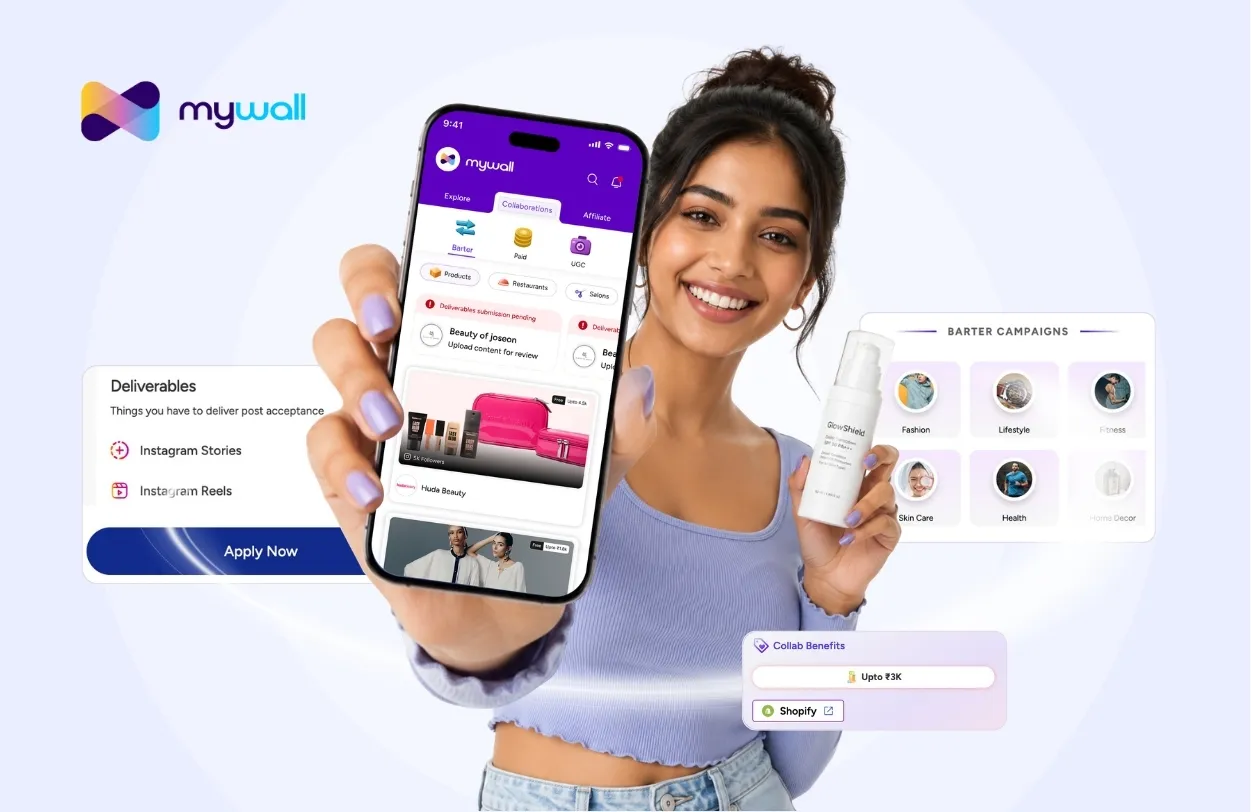
MyWall handles the full workflow in one place: brands discover creators through filterable search, launch a barter listing that verified creators apply to directly with their rates and past work attached, manage incoming applications without cold outreach, coordinate product or service delivery, track submitted content through to approval, and measure results against campaign goals — all from a single dashboard instead of spreadsheets, DMs, and shipping trackers.
What makes MyWall specifically well-suited to barter, rather than just campaign management in general, is the MyWall creator marketplace itself: creators apply to open barter listings, which removes the cold-outreach problem that makes manual barter programs slow to fill. Combined with MyWall Genie's competitor intelligence and AI Executive's automated follow-ups, brands can run barter at real volume — dozens or hundreds of creators — without the coordination overhead that normally caps how big a barter program can get. And because MyWall runs paid, UGC, and affiliate campaigns from the same dashboard and creator base, a barter creator who performs well can move straight into a paid or affiliate relationship without switching tools.
Littlebox X Mywall: How Littlebox Scaled a Barter Campaign With No Budget
As a Global barter influencer platform, one of MyWall's clearest results is the Littlebox fashion barter campaign, a fashion push where the brand ran barter alone, at volume, rather than blending it with paid. The idea was simple: activate a lot of creators at once, then see which formats, hooks, and creator types actually worked before spending more on what performed best.
- 300+ creators activated across Instagram
- 300+ videos produced, using a reels-first approach layered with Stories for extra frequency and recall
- 1.5 million-plus impressions generated from the campaign
Results reflect this specific brand, category, and campaign — not a guarantee for every brand.
Common Mistakes to Avoid
Picking creators by follower count alone is the most common mistake, but not the only one. Brands often send products with no clear objective, leave deliverables undefined, or expect paid-tier polish from a barter arrangement. Running barter with no tracking system means there's no way to know afterward what worked, and skipping disclosure requirements creates real regulatory risk. The biggest mindset error: treating barter creators as free advertising instead of a genuine partnership.
Measuring Barter ROI
Track content metrics (creators activated, content pieces, reach, engagement) alongside commercial metrics where attribution is possible (clicks, coupon usage, conversions). Content also has reuse value beyond its original post — in paid ads or on owned channels — worth counting separately from organic reach.
A simple way to frame it: Barter Campaign ROI = Value Generated ÷ Total Campaign Cost, where cost includes the actual value of what was gifted plus shipping and management overhead — not just the sticker price. There's no universal benchmark for a "good" barter ROI; it depends on category and margin.
When Should a Brand Choose Barter, Paid, UGC, or Affiliate?
| Campaign Goal | Recommended Model |
|---|---|
| Product seeding | Barter |
| Hotel or travel experience | Barter |
| Guaranteed deliverables | Paid |
| Performance-driven sales | Affiliate |
| Content for owned channels | UGC |
| Product launch | Paid + Barter |
| Creator testing | Barter |
| Long-term partnership | Paid + Affiliate |
Hybrid campaigns often outperform relying on one compensation model — matching the right incentive to the right stage of a creator relationship.
Barter Doesn't Eliminate Cost — It Changes the Economics
Barter doesn't make influencer marketing free; it changes what a brand spends — product or experience value instead of cash. When brands pick the right creators, offer real value, set clear expectations, and measure results, barter becomes a scalable part of a broader creator strategy, not a one-off experiment.
As programs grow, the operational side — discovery, applications, logistics, tracking — becomes the real bottleneck. MyWall is built specifically to remove that bottleneck, bringing creator discovery, barter, paid, UGC, and affiliate collaboration into one connected platform.



 820, Golf Course Road Sector 42, Gurugram Haryana -122001, India
 support@mywall.me
 +91 81305 73468


