How to Find the Right Influencers for Your Brand and Niche

Contents
- What Actually Makes an Influencer the Right Fit?
- A Simple Framework for Finding the Right Influencers
- What Is a Creator Discovery Platform?
- What Is MyWall?
- Find the Right Creators Using MyWall
- MyWall Genie: Competitor Creators & Inspiration
- AI Executive: Automated Outreach and Follow-Ups
- The Rest of MyWall's Workflow
- MyWall vs. Manual Influencer Search
- Before You Reach Out
- Common Mistakes to Avoid
- The Takeaway
Influencer marketing has become a real customer-acquisition channel, not a side experiment. The industry crossed roughly $32 billion in 2026, and around 86% of U.S. marketers now work with creators in some form. Done well, it pays off: brands report an average of $5.78 back for every $1 spent, and the best programs push that closer to $18–$20.
But that average hides a big gap. A recent audit of 100,000 influencer accounts found that over a third of followers were fake or suspicious. Brands that skip proper vetting lose an average of $18,500 per fraudulent campaign, and losses run into the hundreds of thousands once spend scales up. Most of these losses trace back to the same handful of avoidable errors: picking by follower count alone, skipping a check on where the audience actually lives, or greenlighting a creator without looking at how their past sponsored content performed. The gap between brands that win and brands that waste money almost always comes down to one decision: which creator they picked.
This article breaks down how to actually make that decision, what "the right fit" means, how to search and shortlist creators step by step, and how a dedicated discovery tool changes that process once you're managing more than a handful of creators.
What Actually Makes an Influencer the Right Fit for Your Brand?
A creator is the right fit when their niche, audience, location, and content style match your brand, not just because they have a big following.
Niche relevance means they post about your category consistently, over months, not just once. Audience fit is about who's actually following them. Their followers' age, interests, and buying habits should look like your customer.
Engagement quality is different from engagement rate. A comment from a bot account still counts toward the rate, but it means nothing. A real reply from someone who looks like an actual customer is worth far more.
Geography matters too, and it's easy to get wrong. A creator based in one country can easily have followers spread across a dozen others. So checking where their audience lives matters more than checking where the creator lives.
A few other things worth checking: has this creator worked with your competitors before, and did the partnership look genuine or just paid-and-posted? Do their past sponsored posts show any real results, or a pattern of posts that got no traction?
None of these factors work alone. A creator can look great on paper, right niche, right audience, and still be wrong for your brand if the tone doesn't match.
A Simple Framework for Finding the Right Influencers
Work through these steps roughly in order. Each one narrows your list before you move to the next.
- Define your goal. Awareness, conversions, UGC for ads, or affiliate sales each need a different type of creator.
- Know your audience. Write down your customer's age range, interests, and platform habits before you start looking at profiles.
- Get specific about your niche. "Fitness" is too broad. "Postpartum strength training for new moms" is specific enough that you'll actually find the right creator community.
- Decide what geography means for this campaign. Do you need creators based in a specific place, or creators whose followers live there? These are two different requirements.
- Pick the right creator size. Nano (1K–10K), micro (10K–50K), mid-tier (50K–500K), and macro creators trade off reach, cost, and trust differently. Smaller creators usually get higher engagement.
- Search and build an initial list. Use hashtags, competitor tags, and platform search to find candidates.
- Check audience and engagement quality. Look at engagement ratios, comment authenticity, and audience demographics before narrowing further.
- Review their sponsored content. Did they disclose properly? Did the ad still sound like them?
- Build a shortlist and compare. Put your finalists side by side, judged on the same criteria, rather than evaluating each one individually.
This process works fine for a handful of creators. The problem shows up once you're trying to do it across dozens or hundreds of profiles, that's when manual search stops scaling, and a dedicated discovery tool starts to matter.
What Is a Creator Discovery Platform?
A Creator Discovery Platform is software that lets brands search, filter, and evaluate creators using real audience and engagement data, instead of doing all of that research by hand across five different apps.
A few related terms get mixed up, so it's worth separating them. An influencer search tool is just the filtering feature on its own. An influencer database is the raw dataset those filters search through. An influencer marketplace works the other way around, creators apply to campaigns brands post, instead of brands reaching out first. A discovery platform sits at the front of the process (search and shortlisting), while full influencer management software goes further into outreach, contracts, and reporting.
What Is MyWall?
MyWall is an AI-powered influencer marketing platform built to run the entire creator campaign lifecycle, discovery, outreach, execution, and reporting, from one connected workspace, instead of requiring a separate tool for each stage. It's used by ecommerce and DTC brands, consumer product companies, and agencies to find the right creators, manage campaigns across paid, barter, affiliate, and UGC collaborations, and track results as they happen.
The rest of this guide walks through MyWall's core features in depth, starting with the part most brands use first: the AI-powered influencer discovery tool.
Find the Right Creators for Your Brand Using MyWall Tool
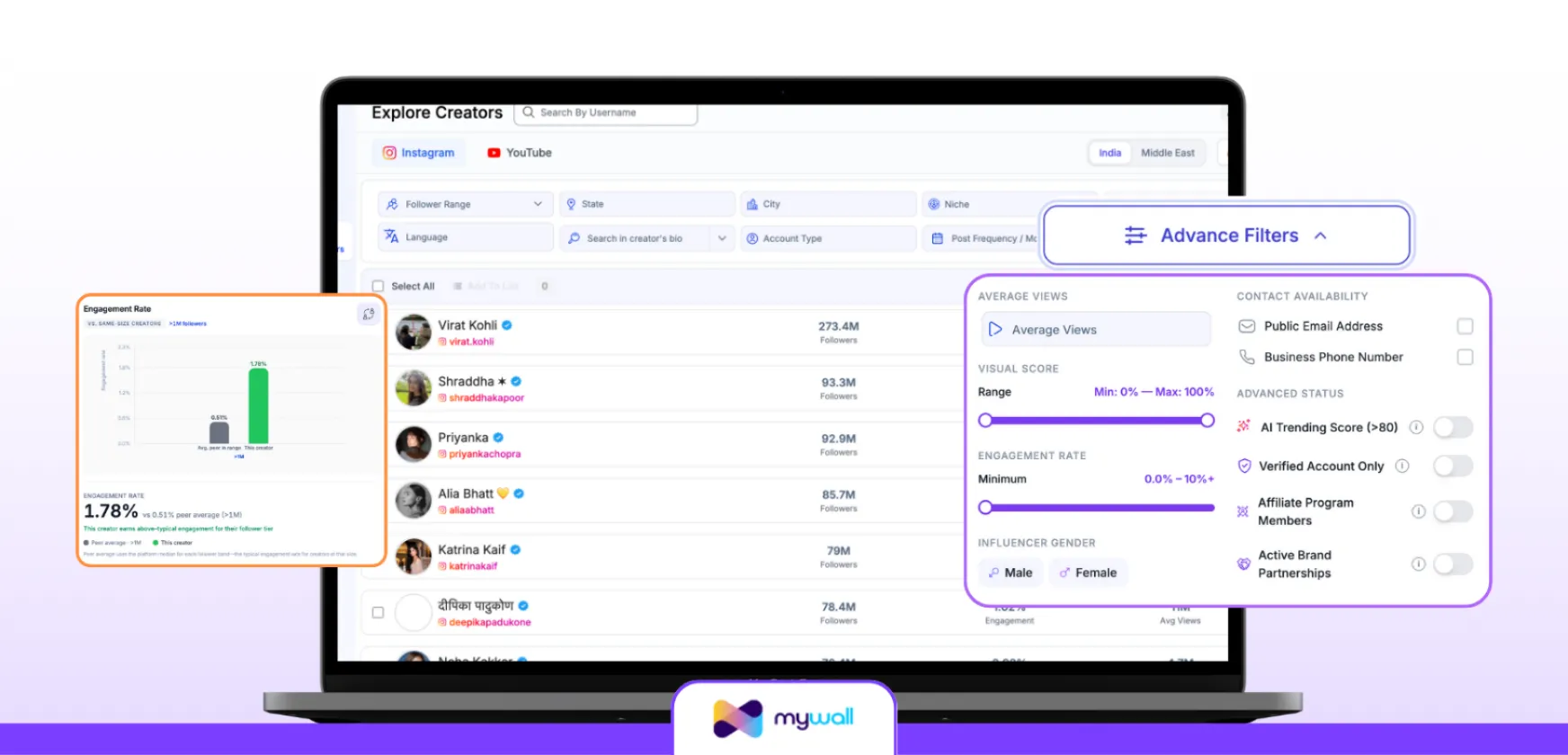
MyWall's AI-Powered Influencer Discovery Tool is the feature most brands use first. It searches a 150M+ creator network in one place, using AI-driven filtering and matching to surface creators who fit a brand's niche, audience, and content style, instead of manually searching each social platform on its own. Here's how the process actually works, step by step.
- Search the creator network. MyWall's database covers 150M+ creators. Instead of searching one platform at a time, you search all of them from one place.
- Apply filters. MyWall gives you 30+ filters to narrow the list, niche, engagement rate, view count, follower size, location, age, and gender. One filter that's harder to find elsewhere is a visual content score, which rates how well a creator's aesthetic and content quality fit your brand, not just their numbers. This matters because two creators with identical follower counts can produce completely different quality content.
- Review each creator's profile. Every result shows the data you'd otherwise have to dig up manually, audience breakdown, engagement history, and past collaborations, so you're comparing creators on the same information instead of piecing it together from screenshots.
- Use look-alike search. If you already have a creator who's performing well, MyWall can find others with similar audience and content patterns. This is useful once you know what "working" looks like for your brand and want to find more of it.
- Shortlist and bulk-invite. Once you've narrowed your list, you can invite multiple creators to a campaign at once instead of messaging each one individually. This is what makes discovery repeatable, the same process works whether you're running one campaign or ten.
Ready to see it in action? Try MyWall's Creator Discovery tool and filter your way to creators who actually fit your brand.
MyWall Genie: Find Your Competitors' Winning Creators and Get Content Inspiration
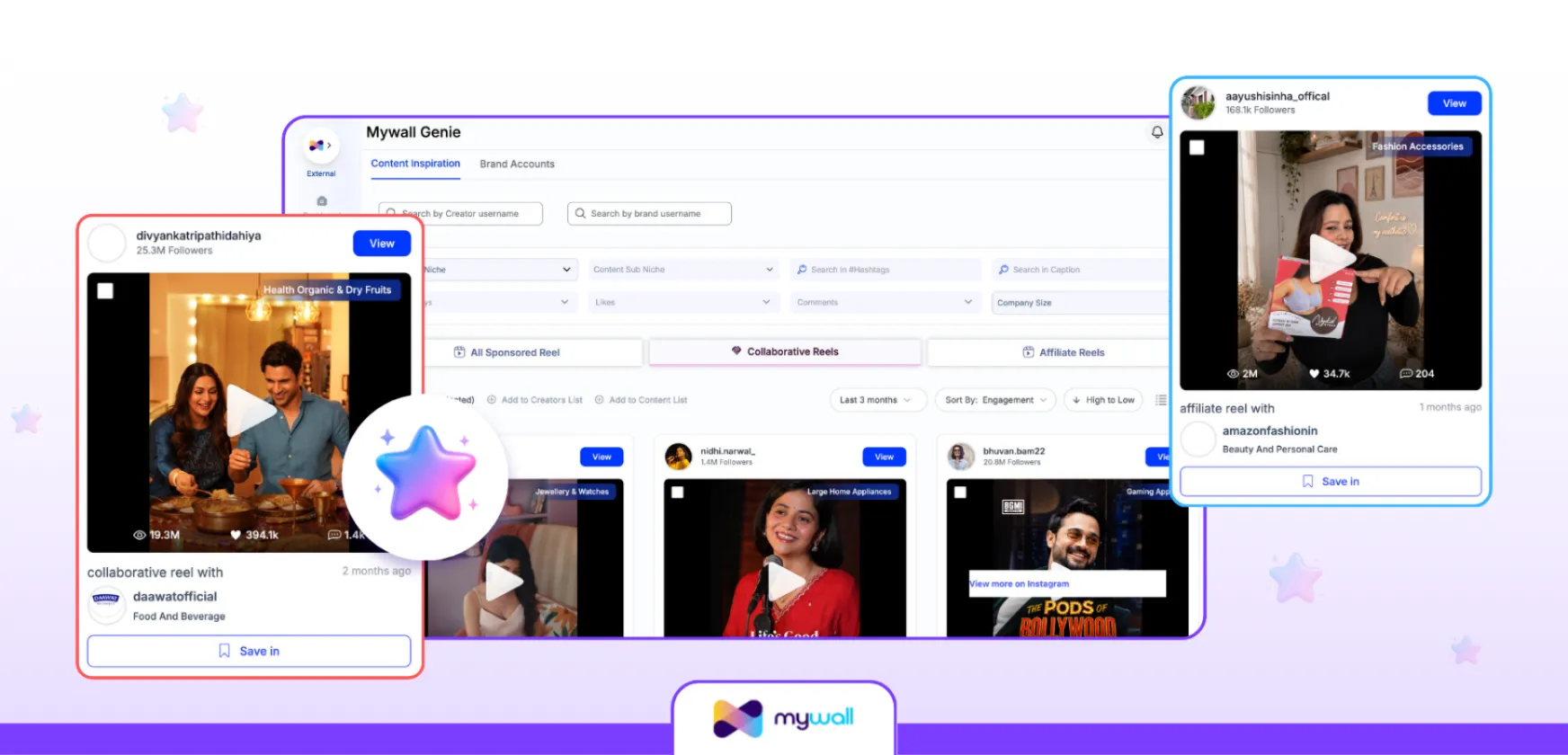
MyWall Genie is a built-in AI assistant that sits alongside the discovery tool. Its core strength is competitor analysis; it shows a brand exactly which creators their competitors are already working with, so decisions get made on evidence instead of guesswork.
It surfaces competitor collaborations. Genie pulls up the specific creators a competitor has partnered with, including recent ones, so a brand can see who's already active in their category rather than starting a search from zero.
It breaks down what content is actually working. For each of those collaborations, Genie shows which posts performed best, the format, style, and angle that got real engagement, so a brand can see what's landing with a shared audience, not just who was hired.
It shortlists creators for you. Instead of manually applying every filter, you can describe what you're looking for in plain language, and Genie narrows the pool based on your brief.
It drafts outreach messages. Genie writes a first draft of your outreach based on the creator's profile and your campaign goals, so you're not starting from a blank message every time.
Put together, this turns competitor research from a manual guessing game, scrolling competitor pages and hoping to spot a sponsored post, into a direct, evidence-based starting point for who to approach and what kind of content to brief them on.
AI Executive: Automated Outreach and Follow-Ups
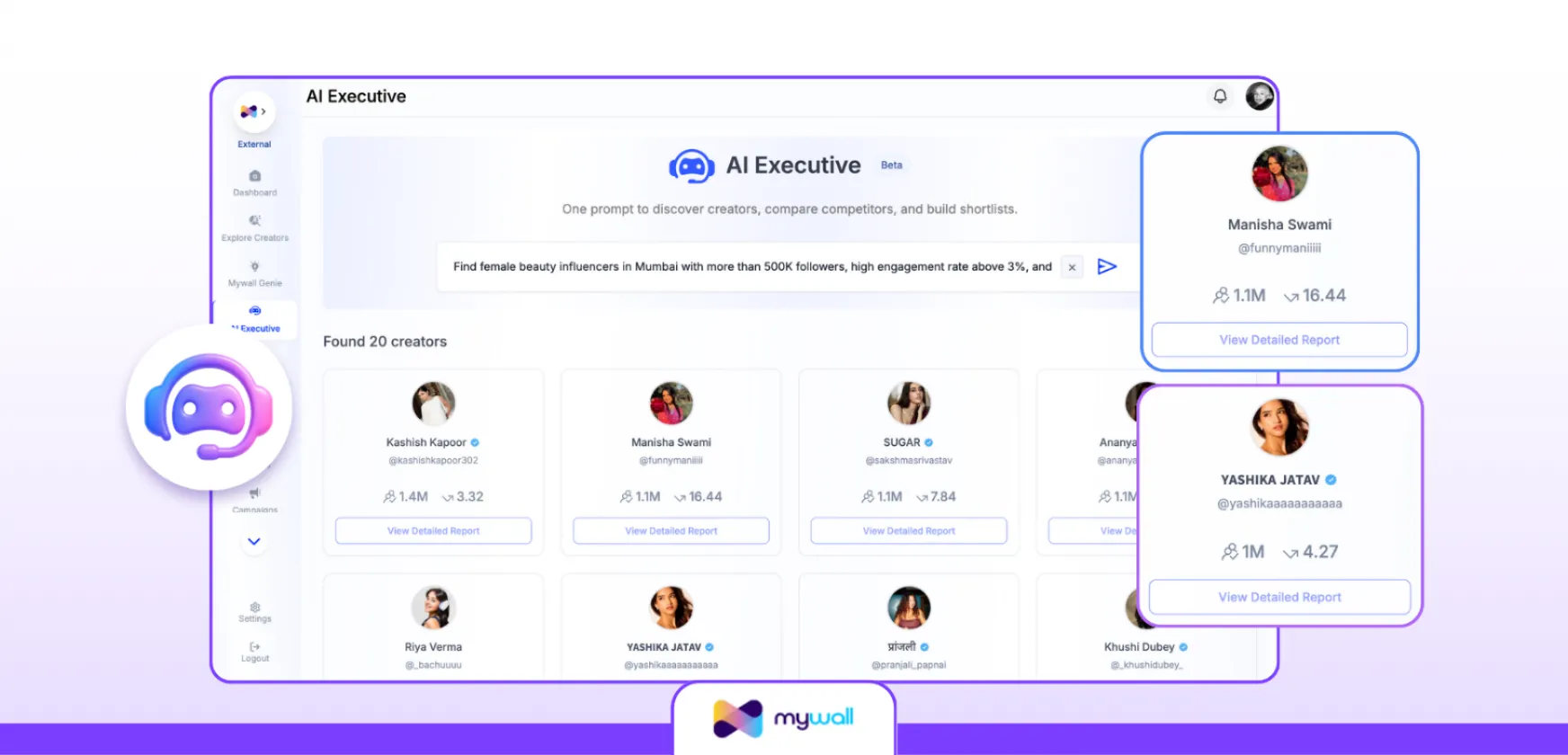
Once a shortlist is built, the next bottleneck is usually outreach, sending messages, following up, and keeping track of who's responded. AI Executive automates that part.
It sends outreach follow-ups automatically, so a creator who hasn't replied doesn't just sit there until someone remembers to check. It nudges collaborations along in the background, and it can effectively kick off a campaign from a single prompt, handling the repetitive back-and-forth that usually eats up a campaign manager's time. This doesn't replace the human decision of who to work with; it just removes the manual chasing once that decision is made.
The Rest of MyWall's Workflow
Beyond discovery and outreach, a few other features round out the platform.
- End-to-end campaign management. MyWall runs paid, barter, affiliate, and UGC campaigns from the same dashboard, using the same creator base, briefs, and approval steps regardless of the collaboration type.
- Real-time ROI tracking. As content goes live, MyWall tracks reach, impressions, click-through rate, and conversions per creator and per campaign, instead of waiting for a report after the campaign ends.
- A unified influencer CRM. Every creator relationship, rate, and past collaboration is stored in one record, so nothing gets lost in an old email thread or someone's personal spreadsheet.
- A marketplace layer. Alongside brand-led search, MyWall also lets brands post open campaigns that verified creators can apply to directly, with their rates and past work already attached. This gives brands a second, inbound way to find creators, and gives creators a way to find paid work through the platform too.
- Global reach. MyWall operates across 14+ countries, including the US, India, the UAE, the UK, Australia, New Zealand, and Brazil. A brand running campaigns in more than one market can manage all of them from a single dashboard, instead of relying on local tools or agencies per region.
MyWall vs. Manual Influencer Search: What Actually Changes
Switching from manual influencer research to MyWall changes eight parts of the workflow in particular, how you search, filter, evaluate audiences, track competitors, manage outreach, store relationships, reach creators in other markets, and scale the whole process.
| Factor | Manual Search | MyWall |
|---|---|---|
| Search | One platform, one hashtag at a time | Centralized search across niches and platforms |
| Filtering | Whatever the app's native search allows | 30+ filters, including a visual content score |
| Audience analysis | Manually scrolling comments and followers | Structured demographic and quality data |
| Competitor research | Manual tracking | Built into MyWall Genie |
| Outreach | Individual DMs and emails, easy to lose track of | Centralized, with AI Executive follow-ups |
| Relationship history | Scattered across inboxes and spreadsheets | Stored in one influencer CRM |
| Global reach | Local knowledge only | Creators across 14+ countries, one dashboard |
| Scalability | Breaks down past a handful of creators | Built for dozens or hundreds |
Before You Reach Out
Once you've got a shortlist, check it against this list one more time: niche and audience fit, location, engagement quality, content quality, authenticity, how past sponsored content performed, competitor relationships, brand safety, and whether the expected cost matches the expected return. Creators who clear most of this belong in outreach. Creators who only clear the follower count usually don't.
Common Mistakes to Avoid
Picking creators by follower count alone is the obvious mistake, but it's rarely the only one. Brands often skip checking where a creator's audience actually lives, mistake high engagement for real brand fit, don't bother reading past sponsored posts, or miss that a creator just ran a near-identical campaign for a direct competitor. Reaching out without a clear brief wastes everyone's time, and running discovery across five separate tools makes it hard to tell what actually worked once the campaign ends.
Finding the Right Influencer Starts With Better Discovery
The strongest influencer programs aren't built on the biggest follower counts. They're built on getting the fit right, consistently, every time, which is hard to keep up manually once a program grows past a handful of creators.
As programs scale, discovery, outreach, campaign management, and tracking need to work together instead of living in five separate tools. That's the problem MyWall is built to solve: one platform that combines AI-powered discovery, competitor intelligence, automated outreach, campaign management, and real-time ROI tracking, so finding the right creator becomes a repeatable process instead of a one-off search.
Frequently Asked Questions
How do I find the right influencers for my brand?
What is a Creator Discovery Platform?
Does MyWall operate globally?
What's the difference between an influencer marketplace and an influencer marketing platform?
What is influencer CRM software?
How do brands measure influencer ROI?


 820, Golf Course Road Sector 42, Gurugram Haryana -122001, India
 support@mywall.me
 +91 81305 73468


