How to Run Your First Influencer Campaign: A Practical Plan for Small Brands
Contents
- Step 1: Define One Clear Goal for Your First Campaign
- Step 2: Set a Realistic Starting Budget
- Step 3: Find Influencers Who Actually Fit Your Brand
- Step 4: Reach Out and Set Clear Terms
- Step 5: Run the Campaign Without Losing Track of the Details
- Step 6: Measure What Actually Matters for a First Campaign
- Your Next Campaign: What to Change and What to Keep
If you're a small business owner staring at the phrase "influencer marketing" and feeling like everyone else already has a playbook you missed, you're not behind. Most small businesses begin influencer marketing the same way: with one product, one creator, and one specific thing they want to find out. If you've been searching for how to start influencer marketing for small business, the honest answer is that there's no secret onboarding process. You pick a starting point, run a small test, and learn from what actually happens rather than what a case study says should happen.
A first campaign is different from a scaled-up program in one important way: its job isn't to prove influencer marketing works in general. Its job is to teach you, specifically, what works for your brand, your budget, and your audience. A mature program might run dozens of creators across multiple platforms at once. Your first campaign should do the opposite: one goal, one or two creators, and enough structure that you can actually tell what happened afterward.
This guide walks through that structure step by step, built around the real constraints most small businesses face: no dedicated marketing team, a limited budget, and no appetite for a six-week agency onboarding process. Treat it as a starting plan you can execute in the next few weeks, not a strategy document to revisit someday.
Step 1: Define One Clear Goal for Your First Campaign
What goal should a small brand set for its first influencer campaign?
Pick exactly one. Trying to chase brand awareness, sales, email signups, and social growth all at once with your first campaign makes it impossible to know afterward whether the campaign worked or you just got lucky on one metric.
For a first campaign, the most useful goals tend to be the ones you can measure without complicated tracking setups:
- Direct sales or sign-ups: using a unique discount code or trackable link
- Content you can reuse: photos or videos you can repost on your own channels
- Audience validation: seeing whether a specific creator's audience actually engages with your product
Avoid vague goals like "get more visibility" or "build brand awareness." They feel safe, but they give you no way to judge success or failure at the end, which defeats the purpose of a first test. Write your goal down as a single sentence before you do anything else: "I want to see if [creator's audience] will use a discount code to buy [product] within two weeks of the post going live." Everything else in this guide flows from that one sentence.
Step 2: Set a Realistic Starting Budget
How much should a small business budget for its first influencer campaign?
There's no universal number that applies to every small business, and any article that hands you a specific rupee figure without knowing your industry, product price point, or the creator's audience size is guessing. What matters more than the exact amount is that the budget matches the scale of a test, not a launch. You're paying for information as much as possible.
What are low-cost ways to start influencer marketing?
A few approaches let small businesses start without a large cash outlay:
- Product gifting: sending free products in exchange for honest content, common with smaller or newer creators who are building their own portfolio
- Micro-influencers: creators with smaller, more engaged audiences typically cost less per collaboration than large influencers and often deliver stronger engagement rates relative to their size
- Performance-based terms: offering a commission or affiliate structure tied to actual sales rather than a flat upfront fee
- Barter plus a small fee: combining free product with a modest payment, which tends to get more reliable delivery than gifting alone
Whatever route you choose, decide your ceiling before you reach out to anyone. Knowing your maximum spend in advance stops a friendly negotiation from turning into scope creep.
Step 3: Find Influencers Who Actually Fit Your Brand
How do I find the right influencers for my small business?
You don't need a specialized tool to start. Look at who already engages with your brand: check who comments on your posts, tags you, or follows accounts similar to yours. Search relevant hashtags in your niche and scroll through the results. Look at your competitors' followers and engagement. This manual approach is slow, but it's free and it teaches you what "good fit" actually looks like for your audience.
If you want a broader starting pool, discovery tools vary widely in scale and approach. Some, like Influencer Hero, market themselves around large-scale creator databases, while others, like Talentrack, position themselves as smaller, more curated and verified pools, and platforms like Starbuzz.ai point to their existing brand client base as a mark of credibility. Exact numbers for these platforms aren't independently verified and tend to change over time, so it's worth treating any specific figures you see on their sites as marketing claims rather than confirmed data. These differences matter more at the conceptual level: a larger database gives you options but more sifting; a smaller, verified pool gives you less choice but more built-in vetting. Neither is inherently better for a first campaign; it depends on how much manual screening you're willing to do yourself.
What should I look for in an influencer besides followers?
Follower count is the least reliable signal for a first campaign. Instead, look at:
- Engagement rate: comments and shares relative to follower count matter more than raw reach, since a smaller account with active, real conversations often outperforms a large one with silent followers
- Niche fit: does this creator's content genuinely relate to your product category, or would your brand feel out of place in their feed?
- Audience overlap: do the people commenting look like your actual customers, based on language, location, or the kinds of questions they ask?
- Content quality and consistency: can they produce something that looks credible without heavy direction from you?
- Past brand collaborations: how have they handled sponsored content before, and did their audience react well to it?
For a first campaign, one or two creators who genuinely fit your niche will teach you more than five who simply have large followings.
Step 4: Reach Out and Set Clear Terms
How do I approach an influencer for the first time?
Keep the first message short, specific, and honest about the fact that you're a smaller brand. A direct message or email that explains who you are, why you chose them specifically (reference something from their actual content), and what you're proposing tends to get better responses than a generic pitch. Influencers, especially micro-influencers, can usually tell within a sentence or two whether a brand actually looked at their page or is mass-messaging.
What should be agreed on before starting a collaboration?
Before any content gets made, put the following in writing, even if it's just a simple email confirmation rather than a formal contract:
- Deliverables: exactly what content (how many posts, stories, reels) and on which platform
- Timeline: when content goes live and any deadlines for drafts or approvals
- Payment or product terms: amount, method, and timing, or the value and terms of any gifted product
- Usage rights: whether you can repost their content on your own channels and for how long
- Disclosure requirements: making clear that sponsored or gifted content needs to be labeled appropriately
Skipping this step is the most common reason first campaigns go wrong, not because creators are unreliable, but because expectations were never made explicit on either side.
Step 5: Run the Campaign Without Losing Track of the Details
How do I manage an influencer campaign as a small team?
Even a single-creator campaign generates a surprising number of moving parts: draft approvals, revision requests, posting confirmations, tracking links, and follow-up messages. With no dedicated team, the easiest way to lose control of a first campaign isn't a bad creator choice; it's simply losing track of who agreed to what and when.
A simple shared document or spreadsheet works for tracking one or two creators: list deliverables, deadlines, approval status, and payment status in one place so nothing depends on memory or scattered DMs.
What tools can simplify running a first campaign?
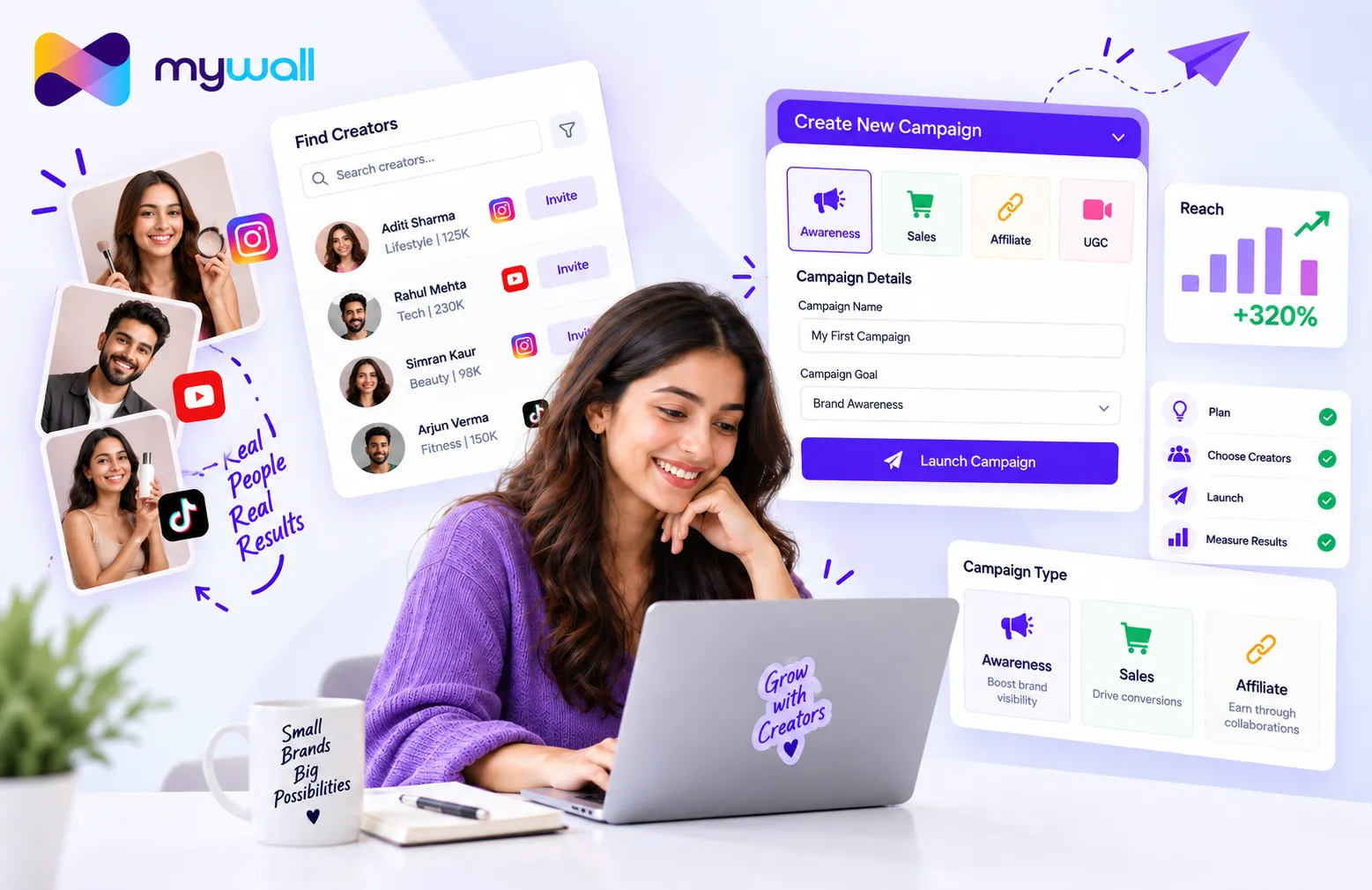
Once you've run through goal-setting, budgeting, discovery, and outreach manually and understand what each step actually involves, the coordination work is often where the real time cost shows up, especially if you scale beyond one creator. This is where a dedicated tool can help rather than complicate things. An AI-powered influencer marketing platform like MyWall can take over the repetitive parts of this process, including surfacing relevant creators, tracking content approvals, and centralizing communication, so you're not managing a first campaign entirely through spreadsheets and inboxes. It's worth introducing at this stage precisely because you now understand what the platform is actually replacing, rather than treating it as a mandatory first step before you've learned the basics.
Step 6: Measure What Actually Matters for a First Campaign
How do I know if my first influencer campaign worked?
Go back to the single goal you defined in Step 1 and measure against that, not against every metric available. If your goal was sales through a discount code, count redemptions. If it was content you could reuse, evaluate whether the content actually met your quality bar. If it was audience validation, look at whether comments and shares suggested genuine interest rather than passive scrolling.
What metrics matter for a small brand's first campaign?
Avoid getting distracted by vanity metrics like impressions or follower growth alone, they tell you reach happened, not whether it mattered. More useful metrics for a first campaign include:
- Engagement rate on the specific post: comments, shares, and saves relative to the creator's typical performance
- Trackable conversions: discount code redemptions, unique link clicks, or direct attributed sales
- Content usability: whether the creator delivered something you can actually reuse in ads or on your own channels
- Qualitative signal: did the comments section suggest people trust the recommendation, or did it feel forced?
Calculating ROI on a first campaign is often rougher than on a mature program simply because you don't have historical benchmarks yet. That's fine. The goal isn't a polished ROI report, it's a clear enough picture to decide what to do next.
Your Next Campaign: What to Change and What to Keep
What should a small brand do after its first influencer campaign?
Write down what happened while it's fresh: which parts of outreach felt smooth, where communication broke down, whether the creator's audience matched expectations, and whether the content performed close to, above, or below what you hoped. This isn't a formal debrief, just a short honest note to yourself.
From there, decide what to keep and what to adjust. Maybe the goal was right but the budget was too tight for the creator tier you approached. Maybe engagement rate turned out to be a better predictor of success than niche fit. Maybe the outreach message needs to be more specific next time. Each first campaign gives you at least one concrete lesson that a general playbook never could, because it's based on your actual audience and product rather than an average case.
The point of starting small isn't just to reduce risk. It's to turn influencer marketing from an abstract idea into a repeatable process you actually understand, one you can scale with a second creator, a slightly larger budget, or a tool that handles more of the coordination, once you've already learned what matters through direct experience.



 820, Golf Course Road Sector 42, Gurugram Haryana -122001, India
 support@mywall.me
 +91 81305 73468


