Can AI Really Replace Manual Influencer Campaign Work?
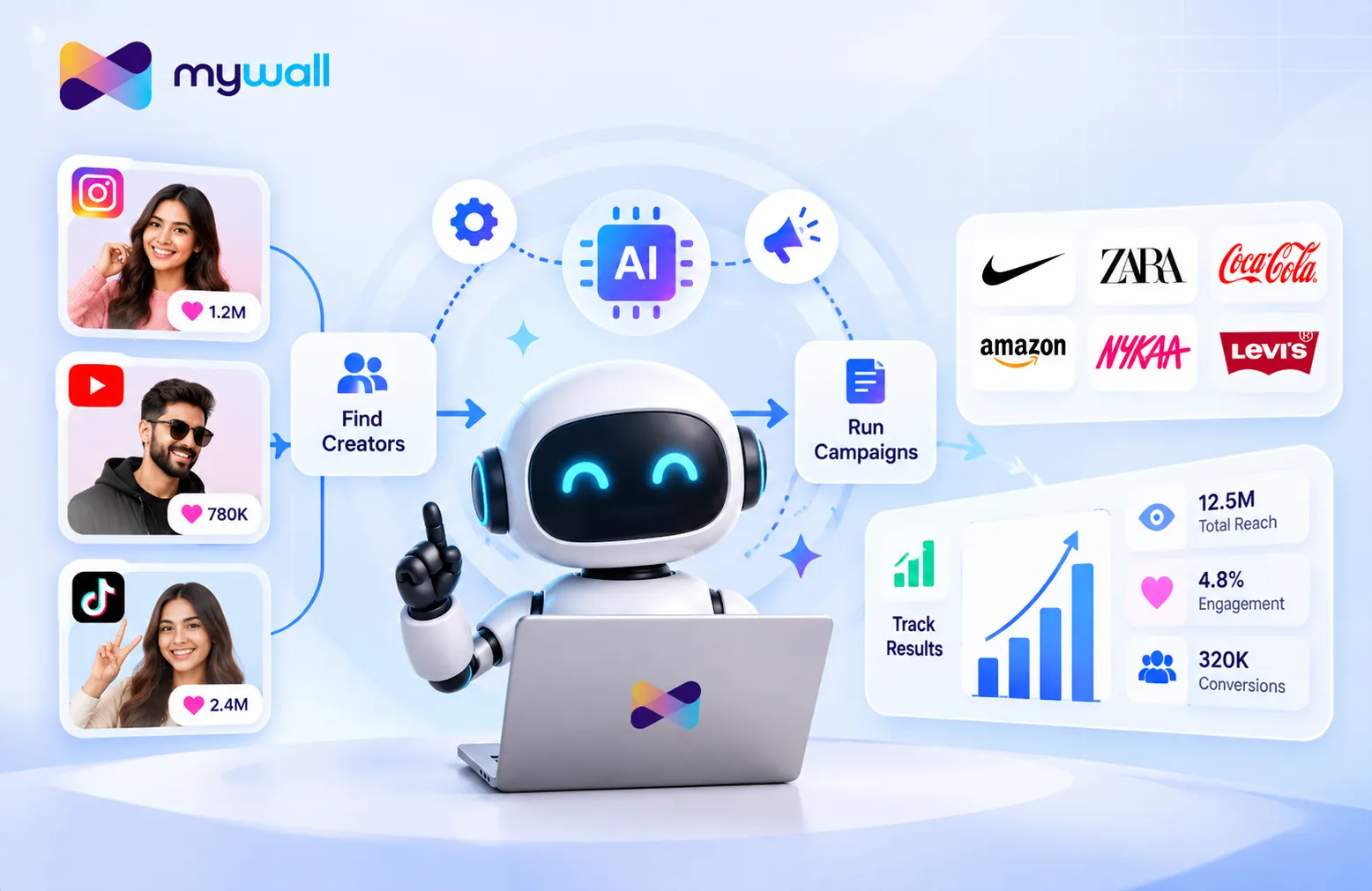
Can AI replace manual influencer campaign management? Not completely. AI can automate many repetitive, data-intensive tasks, from creator discovery and shortlisting to outreach assistance, campaign coordination, and performance reporting - but the level of automation varies by platform and workflow, and human oversight remains important for strategic and relationship-driven decisions. AI influencer marketing tools, including MyWall Genie and AI Executive, both part of MyWall'sAI-powered influencer marketing platform, can automate or assist with several repetitive campaign tasks, such as creator discovery, creator shortlisting, outreach assistance, campaign coordination, and performance reporting. What they don't do is make the judgment calls that used to require your campaign manager's experience: whether a creator's tone actually fits your brand, how to handle a negotiation that's gone sideways, or whether a piece of content will read as authentic to that creator's audience.
Is AI influencer marketing software actually ready to take over core tasks? For the tasks built on structured data — discovery, shortlisting, drafting, reporting, yes, it's ready today. For the tasks built on relationships, trust, and subjective creative judgment, it isn't, and there's no near-term sign that it will be. So if you're evaluating a platform switch and the pitch sounds like "AI runs your campaigns for you," that's not a realistic claim. A more useful question is which specific tasks in your current workflow are automatable, and which would still land on a person's desk no matter which platform you use. That's what the rest of this piece breaks down.
Where AI Genuinely Speeds Up Influencer Campaigns
Creator discovery. This is the clearest win. Manually searching for creators means scrolling platforms, cross-checking follower counts, and guessing at engagement from likes and comments. AI Executive instead queries a structured creator database and surfaces candidates ranked against the metrics that actually predict performance, not just audience size. In MyWall's dataset, for example, engagement rates across creators range from as low as 0.21% (garekarsmddermatologyclinic) to 4.25% (aryanshii09), a gap that's invisible if you're only sorting by follower count. AI-assisted discovery is built to surface that difference quickly.
Shortlisting. Once a discovery list exists, narrowing it down manually means opening dozens of profiles one by one. An AI-assisted shortlist can pre-filter for engagement thresholds, niche, and other stated criteria, so your team starts its review with twenty relevant profiles instead of two hundred unfiltered ones. Creator discovery databases used by tools like these vary widely in size, but the underlying point holds regardless of exact scale: once a database extends into the tens or hundreds of thousands of profiles, some form of automated filtering isn't a convenience; it's a necessity.
Outreach drafting. Writing a personalized first message to each shortlisted creator is one of the more time-consuming manual steps in a campaign. MyWall Genie can draft an initial outreach message using the creator's profile and campaign context as a starting point, which a campaign manager then reviews and personalizes before sending. The AI removes the blank-page problem; it doesn't remove the review step.
Campaign reporting. Pulling performance data into a spreadsheet after a campaign wraps is tedious and error-prone when done by hand across multiple creators and platforms. AI-powered reporting consolidates that data automatically, giving your team a starting report to interpret rather than a data-entry task to complete.
In practice, an AI-powered influencer marketing strategy changes day-to-day work less by replacing decisions and more by shrinking the time between "we need creators for this campaign" and "here's a reviewable shortlist with drafted outreach ready to go."
Where Manual Judgment Still Wins
This is the part vendors tend to skip, so it's worth being direct about it. What can't AI influencer marketing tools do yet? In plain terms: they can't judge brand fit, they can't manage the trust built into an ongoing creator relationship, they can't negotiate, and they can't reliably tell whether a piece of content will feel authentic to an audience. Those four gaps are exactly where brand teams still need manual oversight in influencer campaigns, and they're worth walking through individually.
Brand-fit assessment. Engagement rate tells you a creator's audience is active, not that their content, tone, or values align with your brand. Two creators in MyWall's dataset, preeti_rekha.mua and aryanshii09, sit at 4.33% and 4.25% engagement, respectively, both low by comparison to a creator like passion_for_beautyy. A number like that flags a creator for closer review, but it can't tell you whether the low engagement reflects a mismatched audience, inconsistent posting, or simply a smaller but highly loyal niche following worth investigating further. That judgment call still requires someone to actually watch the content.
Creator relationship management. Long-term creator partnerships run on trust built over repeated campaigns, not on a single data point. Remembering that a creator prefers certain lead times, handling a disagreement over deliverables tactfully, or knowing when to give creative latitude versus tightening brief requirements: none of this is something current AI tools track or manage. It's relational, and it stays with your team.
Negotiation. Rate discussions, usage rights, exclusivity terms: these involve reading tone, understanding leverage, and making judgment calls in real time. AI tools can suggest benchmark rates or flag unusual contract terms, but the back-and-forth of an actual negotiation is still a human conversation.
Creative quality judgment. Whether a piece of content will resonate as authentic, rather than as an obvious ad, is a subjective call that depends on audience familiarity with the creator, current cultural context, and brand voice. AI can check that a brief's requirements were met; it can't reliably judge whether the content feels genuine.
AI Tools vs. Manual/Legacy Platforms: A Side-by-Side Look
| Task | Manual / Legacy Platform | AI-Enabled Workflow (e.g., MyWall) |
|---|---|---|
| Creator discovery | Manual search across platforms, spreadsheet tracking | Database query ranked by engagement and fit signals |
| Shortlisting | Open and review each profile individually | Pre-filtered list based on stated criteria |
| Outreach drafting | Written from scratch per creator | AI-drafted first pass, human-reviewed and personalized |
| Negotiation | Fully manual | Fully manual (AI may surface rate benchmarks) |
| Relationship management | Fully manual | Fully manual |
| Reporting | Manual data pulls and spreadsheet building | Automated consolidation, human interpretation |
| Brand-fit judgment | Manual review | Manual review, sometimes AI-flagged for attention |
The pattern here matters more than any individual row: AI-enabled workflows compress the data-gathering and drafting stages, but they don't touch the negotiation and relationship stages at all. Most legacy platforms, by contrast, don't automate discovery or reporting either, which means your team is doing the manual work at every stage, not just the ones that genuinely require a human. That's the real gap AI-powered influencer marketing tools close, and it's narrower than the marketing around them often suggests, but it's also nothing if discovery and reporting are where your team's hours are actually going. So is switching to an AI-powered influencer marketing platform worth it compared to current tools? It comes down to that table: if your current platform leaves discovery, shortlisting, and reporting entirely manual, switching converts several rows in that comparison from fully manual to partially automated, which is a real time gain. If your legacy platform already automates those same rows reasonably well, the marginal benefit of switching shrinks considerably, and the decision should hinge on other factors instead.
How to Evaluate Whether AI Features Justify a Switch
Before booking a demo, it's worth honestly auditing your own workflow rather than reacting to a feature list. A few questions worth answering internally:
- Where does your team's time actually go? If most hours are spent scrolling for creators and building reports, AI automation addresses a real cost. If most hours go to relationship management and negotiation, an AI upgrade won't move the needle much.
- How large is your creator search radius? Teams working from a small, known pool of repeat creators get less benefit from AI discovery than teams constantly sourcing new creators for shifting campaign niches.
- What does your current platform already automate, if anything? Some legacy tools already handle basic reporting. The comparison that matters is the marginal gain from switching, not AI in the abstract.
- How much manual review will AI output still require? A tool that drafts outreach but requires heavy editing may save less time than it appears to on a demo call. Ask to see raw, unedited AI output, not a polished example.
- Does the platform's data actually cover your niche and market? AI discovery is only as good as the underlying creator database. Ask what's covered before assuming broad applicability.
If the honest answers point to discovery, shortlisting, and reporting eating the bulk of your team's hours, the case for switching is real. If your bottleneck is relationships and negotiation, no AI feature set will fix that, and the decision should weigh other platform factors instead.
The Realistic Verdict — and a Next Step
AI influencer marketing tools are worth taking seriously for a specific reason: they reliably remove the grunt work from discovery, shortlisting, outreach drafting, and reporting, tasks that consume real hours without requiring much judgment once the criteria are set. They are not worth taking seriously as a replacement for brand-fit assessment, negotiation, or creator relationship management, because none of that is close to being automatable yet, and any platform claiming otherwise deserves skepticism.
If the time your team currently loses to manual discovery and reporting sounds familiar, the most useful next step isn't a sales conversation; it's seeing how MyWall's AI-powered influencer marketing platform for brands handles a real discovery and shortlisting task against your own campaign criteria. That's what a brand should actually do next once the AI capability looks promising on paper: request a working session against your own campaign brief and your own creator criteria, not a generic demo, so you can watch the raw output rather than a rehearsed example. A demo, approached that way, is less about being sold to and more about finding out exactly where the automation fits your workflow and where it doesn't.



 820, Golf Course Road Sector 42, Gurugram Haryana -122001, India
 support@mywall.me
 +91 81305 73468


